
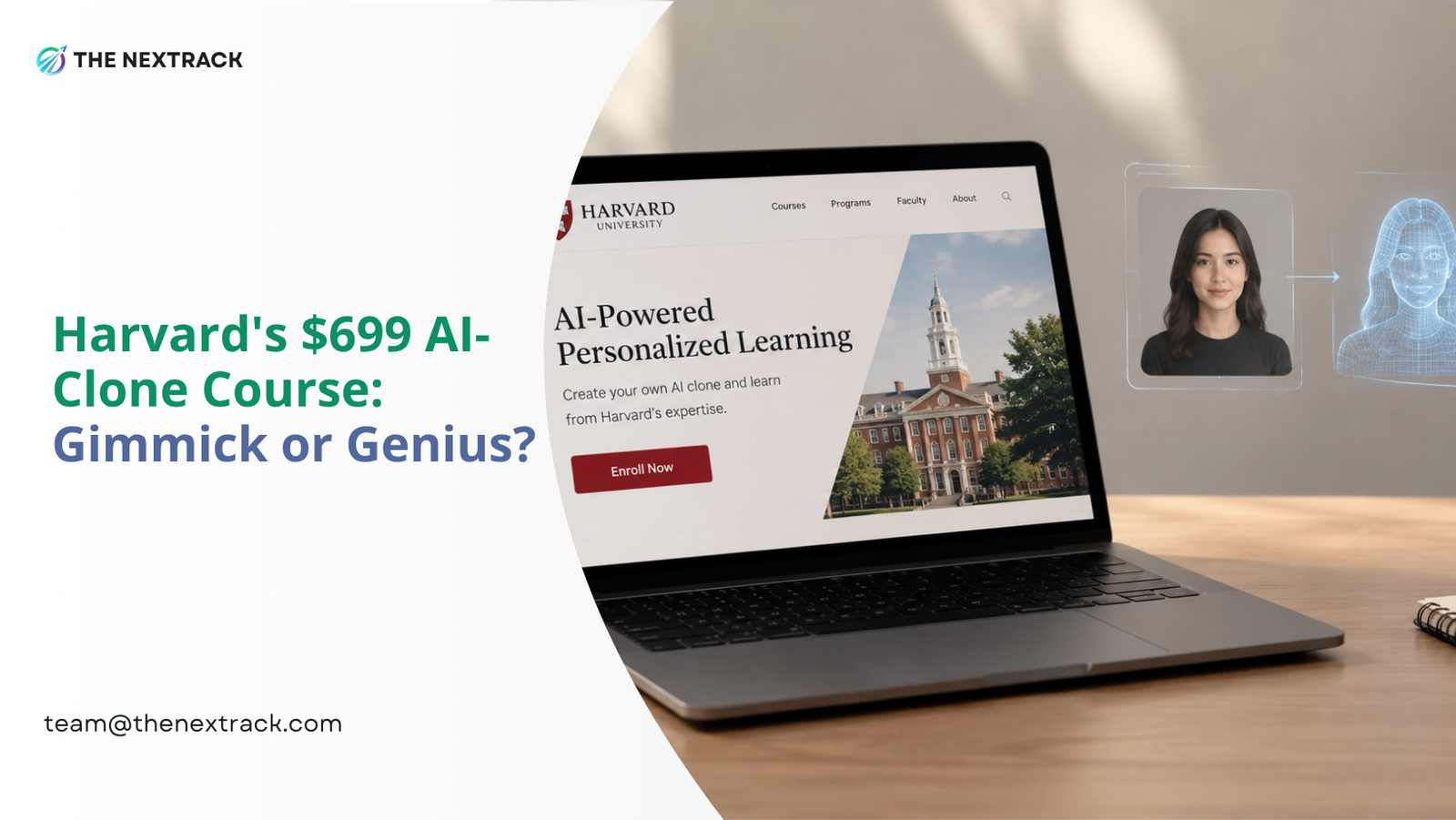
Harvard Business School just dropped a $699 online course starring a fully interactive AI Avatars of a star professor. Naturally, academia is losing its mind. Is this a massive leap forward for scalable learning, or just a cheap gimmick riding on Ivy League coattails? Powered by tech from startups like Beyond Presence and VirtualSpeech, this pilot is forcing us to rethink what online education can actually do.
Inside Harvard’s $699 Experiment: How AI Avatars in Education Are Changing Executive Training
Why the sudden panic? It comes down to the old bottleneck of executive education. Usually, a high-end leadership program at an Ivy League school runs you anywhere from $5,000 to $50,000. They’re expensive because they buy you face-to-face time with elite professors who only have so many hours in a year.
Harvard’s $699 experiment blows right past that constraint by replacing the flesh-and-blood professor with a digital double. This is a far cry from old-school, static online courses. You know the drill: pay a few grand to watch pre-recorded videos of a professor lecturing on a stage back in 2018, stopping only for the occasional multiple-choice quiz. If you wanted to know how a case study applied to your specific business, you posted it in a student forum and crossed your fingers that an underpaid TA would reply by Tuesday.
This pilot flips that script. Instead of zoning out in front of a video, you’re interacting with a real-time digital twin of the instructor. The screen shows an incredibly lifelike avatar that mimics the professor’s looks, speech patterns, and hand gestures. You can talk into your mic or type a highly specific industry question straight to the clone.
Within seconds, the clone serves up an answer built on the professor’s actual papers, books, and lecture transcripts. It isn’t just regurgitating generic ChatGPT responses. It answers as the professor—using their specific frameworks, quirks, and teaching style. Think of it as an infinitely patient, hyper-personalized tutor. It can halt the lecture, dissect a complex financial model, build custom analogies for macroeconomic theories, and quiz you on the fly to make sure you actually get it before moving on.
The Technology Behind Clones: From Personal Brand Licensing AI to Real-Time Coaching
Creating a believable digital twin of a top-tier business thinker takes a serious, multi-layered tech stack. But the process actually starts with lawyers, not code—specifically, contracts for personal brand licensing AI.
When a well-known professor or coach signs off on a clone, they’re licensing their intellectual property: their voice, face, expressions, and teaching framework. It’s a massive shift in how experts monetize what they know. Under these brand licensing agreements, the creator keeps ownership of their brand while giving the platform the rights to stream real-time video and audio of their digital double. This is how AI-clone business coaching scales. Instead of being capped by a 24-hour day, a coach can run custom, high-touch sessions for 10,000 executives at the exact same time—giving each student a tailored experience.
Behind the legal paperwork is the actual tech engine. Traditional video rendering is painfully slow; it used to take hours of processing power just to spit out a single minute of high-quality digital video. To make live, back-and-forth learning work, companies are leaning on fast engines like Beyond Presence 2.0 and VirtualSpeech.
The engine runs on three main pillars:
- The Conversational Core (LLM): A large language model trained exclusively on the instructor’s articles, transcripts, and books. This keeps the clone “in character” and prevents it from hallucinating wrong info.
- The Voice Synthesis Engine: Advanced neural text-to-speech tools that capture the professor’s precise pitch, accent, and cadence. It even includes tiny imperfections like breaths and pauses to keep it from sounding like a robotic automated phone menu.
- The Real-Time Rendering Pipeline: This is where tech like Beyond Presence 2.0 comes in. It cuts video generation latency down to under a second. The moment the LLM writes a response, the video engine syncs the avatar’s lips, matches its facial expressions to the tone of the words, and streams HD video straight to your browser.
Gimmick or Genius? The Real-World Capability of AI Avatars in Education
It’s easy to be cynical here. A lot of people assume AI avatars are just Siri in a tweed jacket—a flashy, expensive novelty built to milk a university’s brand. But once you see what these digital twins can actually do, the “genius” side of the argument gets a lot harder to dismiss.
For starters, a digital twin can do something a real professor lecturing 500 people in a theater never could: instantly spot where a single student is struggling and adapt on the fly. If you’re studying global supply chains from Tokyo, the avatar can detect your native language and explain a dense logistics concept in Japanese before jumping back to English. It can read your answers, realize you’re stuck on basic cash flow math, and quietly pivot to an easier, foundational lesson without making you feel stupid in front of your peers.
There’s also a psychological element at play. Talking to an avatar feels completely different than reading text or watching a standard clip. We are wired to respond to faces, eye contact, and vocal tones—what psychologists call “social presence.” When an avatar nods as you talk, keeps natural eye contact, and moves its hands, your brain treats it like a real social interaction. That alone boosts focus, memory, and engagement.
+-------------------------------------------------------------------+
|                  TRADITIONAL VS. AI-CLONE LEARNING                |
+-------------------------------------------------------------------+
| Feature               | Traditional Online Course | AI-Clone Course|
+-----------------------+---------------------------+----------------+
| Student Engagement    | Passive (Video Watcher)   | Active Partner |
| Content Adaptation    | One-size-fits-all         | Dynamic (RAG)  |
| Response Latency      | Days (Forum post replies) | < 2 Seconds    |
| Soft-Skills Practice  | None (Static text/quiz)   | Interactive    |
+-----------------------+---------------------------+----------------+
Look at the data: platforms like VirtualSpeech have run studies proving these setups actually work for soft skills. People who practiced communication with responsive avatars showed major jumps in confidence, empathy, and active listening. The avatar can play the role of an angry client, a defensive direct report, or a brutal negotiator. It gives you a zero-risk sandbox to mess up, get instant feedback, and try again until you nail it.
Beyond the Ivy League: How Scalable AI Classrooms Compare to Traditional Online Courses
Harvard’s $699 pilot is getting all the press, but this goes way beyond executive business courses. We’re looking at a blueprint for scalable AI classrooms in every corner of education.
Take language learning. Students don’t need to shell out steep hourly rates for native tutors anymore. A digital human can chat with you for hours, gently correcting your accent, throwing in local slang, and adjusting to your pace without ever losing its patience.
In corporate training, compliance and leadership courses are getting a much-needed overhaul. Instead of mindlessly clicking “Next” on boring slideshows, employees have to sit down and negotiate with an AI avatar playing a hostile vendor or an angry customer.
       [Traditional MOOC Classrooms]
       * Linear, non-interactive video playback
       * Scalable but passive learning
       * High student dropout rates
                     vs.
       [Scalable AI-Avatar Classrooms]
       * Dynamic, real-time conversational loops
       * Infinite, low-cost virtual teaching assistants
       * High engagement through interactive roleplay
The business side of this is highly disruptive. If you want to scale a traditional massive online course (MOOC) to 50,000 students, you have to hire a small army of TAs to grade homework, moderate forums, and reply to emails. That overhead grows right alongside enrollment, which always ends up hurting the quality of the course.
But once an institution builds and tests a solid digital avatar, the cost of serving student number 50,001 is basically zero. It bypasses campus capacity limits and teacher burnout entirely, opening up world-class, interactive learning at a tiny fraction of the usual cost.
Frequently Asked Questions
How do Harvard AI courses leverage digital clones for teaching?
They use these clones as live, interactive assistants that chat directly with students. Because they look and sound exactly like the professor, they can answer questions, explain case studies, and give feedback using the professor’s own database of research and publications.
What are the main benefits of using AI avatars in education compared to traditional pre-recorded videos?
The biggest shift is going from passive watching to actual conversation. Instead of just sitting there, you can pause the avatar, ask it questions, roleplay real-world scenarios, and get instant feedback tailored to how fast you’re learning.
How do AI avatars in education scale tutoring and corporate training?
They break the bottleneck of human time. Once a clone is ready, it can run thousands of one-on-one sessions at the exact same time, delivering high-quality training without adding massive extra costs.
How does personal brand licensing AI work for educators and business coaches?
It’s a legal agreement where a creator licenses their voice, likeness, and intellectual property to a tech platform. This lets the platform generate a highly accurate digital double that can coach thousands of students at once while protecting the creator’s legal rights.
Is a $699 AI-clone course worth the investment for professional development?
Yes, if you’re looking to practice soft skills, run interactive roleplays, and get instant feedback without paying Ivy League tuition. But if you’re looking for networking, job placement, or direct peer collaboration, you’ll still need to pay for traditional, human-led programs.
Key Takeaways: The Future of Cloned Educators in Higher Academics
When you’re weighing your own career goals, you have to look at what these clones can and can’t do. They are fantastic for low-stakes practice on tricky soft skills like negotiating, public speaking, or active listening. They’re also an incredibly cheap way to wrap your head around tough concepts, test your knowledge, and get immediate feedback without the stress of a live classroom or the eye-watering cost of a personal coach.
But let’s be real: a digital clone won’t replace a real mentor. It can’t write you a glowing recommendation letter, introduce you to its venture capital network, or co-author a paper after a late-night brainstorm session over drinks. The real value of these cloned teachers is that they open up the basics and the practice drills to everyone. That frees up human professors to do what they do best: mentor, collaborate, and build genuine relationships.
Think of the AI-Clone as a high-powered, interactive workbook. It’s a tool built for practice and repetition. Use it to build your baseline skills cheaply and quickly, and save your hard-earned money and time for the human networks that actually move the needle on your career.